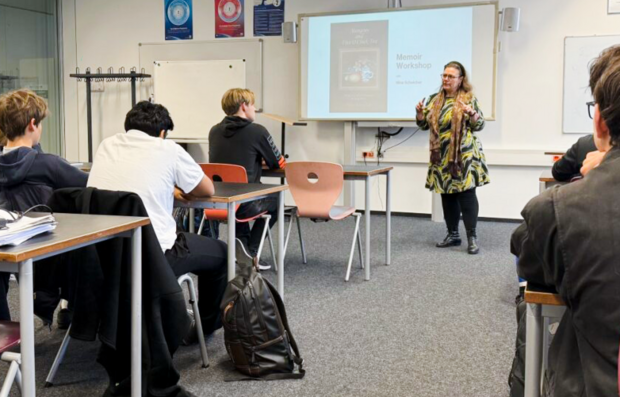
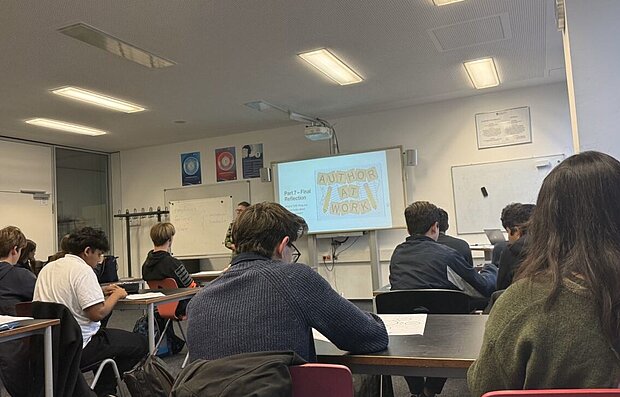
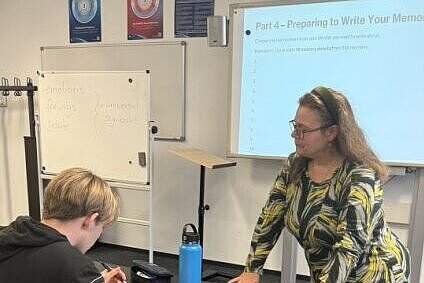
Our MYP5 students took part in a reflective workshop when author Nina Scheicher, writer of Mangoes and Five o’Clock Tea: Memoirs of a Childhood in Singapore, visited their English class. Her presentation, rich in storytelling and personal insight, encouraged students to explore the genre of memoir, with a focus on childhood memoirs. Scheicher opened by explaining that memoir writing is a skill: the ability to pass on experiences, to share the moments that shaped us, and to help readers relate emotionally and personally to a writer’s journey.
To frame the craft, she introduced two well-known childhood memoirs: Angela’s Ashes by Frank McCourt and Wavewalker – Breaking Free by Suzanna Heywood. These texts, she explained, show how memoirists use emotional storytelling to evoke “universal feelings.” Memoirs remind us that “others’ stories help us understand our stories.” Although “we are all different and we are all unique,” she emphasized that people share key emotions that allow readers to connect across cultures, ages, and backgrounds. This sense of similarity is what gives memoir its particular power.
Scheicher then introduced her own memoir, describing how writing it required her to examine her childhood closely and honestly. She encouraged students to do the same. Memoir writing, she said, involves learning “how to tap into your personal story.” It does not require dramatic events or a full life story; rather, a memoir captures “a moment in time.” Writers must focus on small, specific memories because “it doesn’t have to be full or complete… but make it as specific as possible.”
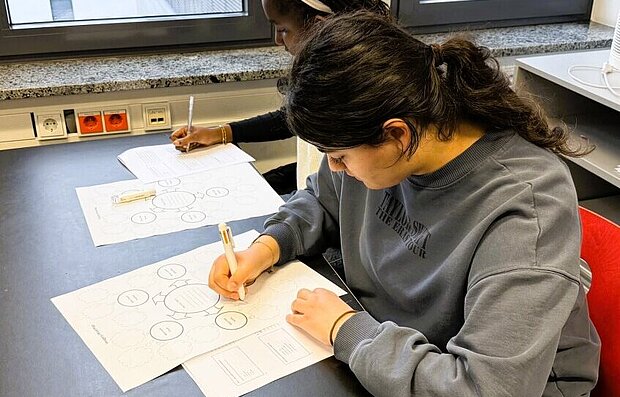
To help students access these moments, Scheicher asked them to start with a memory in thirty seconds—a quick exercise designed to bypass overthinking. After noting a small memory, students built an imagery mind map using the five senses: smell, sight, sound, taste, and touch. Sensory details, she explained, make memories vivid. A memoirist must ask: What did I smell? What did I hear? What did something taste or feel like? She encouraged students to “think of your writing as a camera that zooms into that moment.” The closer the zoom, the clearer the memory becomes, and the more effectively the reader is drawn into the writer’s experience.
Students eagerly shared memories both positive and negative. One described saying “yes” to an unexpected opportunity, using sensory detail to convey the emotions and physical sensations tied to that moment. Another recounted spilling a glass of wine while waitering at a school event: the wobbling tray, the sensation of falling off balance, the dry mouth, and the embarrassment. A third student shared the warmth and imagery of Christmas traditions. As she listened, Scheicher reminded them, “It must be as specific as possible… that’s what makes good writing.”
Throughout the workshop, she posed thought-provoking questions: What distinguishes memoir from other genres? Why do writers rely on sensory detail? What do memories do for readers? Students concluded that sensory memories engage the reader, “throw them into the story,” and shape how people relate to a writer’s emotions. One student summarized: “You need to feel the feeling of another.”
Scheicher then guided the class through a close analysis of excerpts from Angela’s Ashes and Wavewalker. Students compared the sensory techniques used in each, examining how writers build atmosphere, evoke emotion, and balance detail. Scheicher noted that effective memoirs include both positive and negative emotions and that “less is more.” Carefully chosen language can sometimes draw the reader in more powerfully than lengthy description.
The discussion also turned to the challenges of writing memoir. Scheicher shared that while drafting her memoir, she had to unpack layers of memory, a sometimes emotional process. “Not everyone will like what you write,” she cautioned, noting that revisiting personal memories can be painful and that others involved may prefer them forgotten. Still, memoir allows writers to preserve their truth. “While reading a memoir, you are hearing someone speaking,” she said, highlighting the intimacy of the genre. Memoirs can serve many purposes: as meaningful gifts for family, as records that “keep the facts straight,” or simply as a means to look back.
A memorable moment came when Scheicher mentioned her communication with the author of Wavewalker. Curious about the advice she might give young writers, Scheicher contacted Suzanna Heywood, who replied that students should keep a diary. Daily writing, she said, strengthens memory and voice and offers a space to practice noticing details.
Scheicher concluded by reflecting on her own growth: writing her memoir helped her mature further and understand her past. She encouraged students to explore their own stories and reminded them to imagine their writing as a camera zooming in—capturing small truths that reveal larger ones.
By the end of the session, students left with new tools for writing and a deeper appreciation for the value of sharing and shaping personal stories—moments that connect us through the universal language of memory.
Author Bio
Nina Scheicher grew up in Singapore, the daughter of two television journalists, where she developed a lifelong passion for stories, culture, and communication. She holds a master’s degree in translation from Gutenberg University, Mainz, Germany, and a postgraduate HR qualification (CIPD, London). Early in her career, she worked as a tour guide in South Africa during the transition years and later spent eight years in the corporate world with Delphi Automotive Systems, leading company culture workshops during the spin-off from General Motors. She taught CSR and Intercultural Management for ten years at Hochschule Fresenius and currently teachers English for horticulture and landscape architecture students at Hochschule Geisenheim University. She is the author of Mangoes and Five O’Clock Tea – Memoirs of a Childhood in Singapore and enjoys guiding memoir-writing workshops.